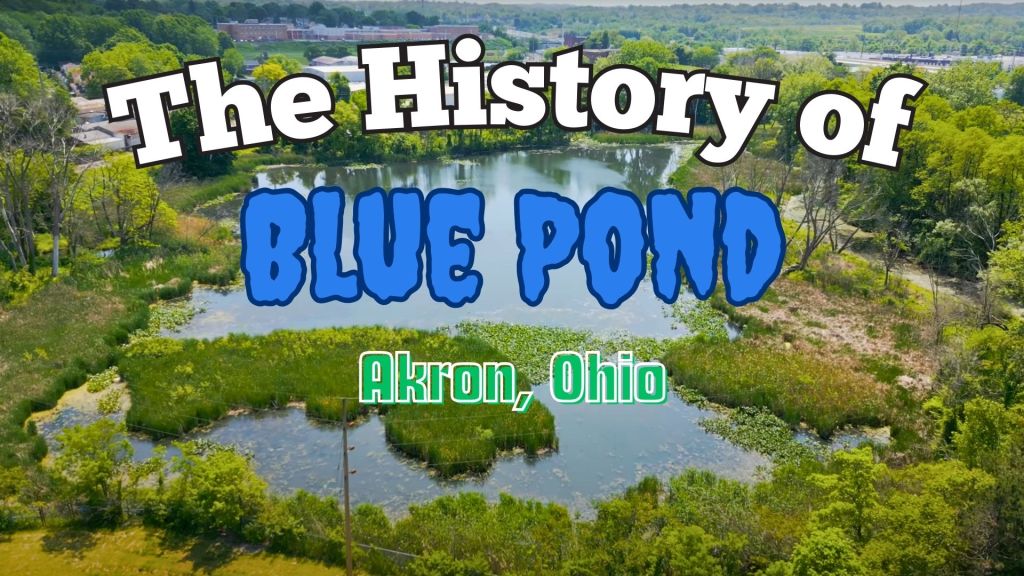
Hello and welcome to Dinklife!
Today, I want to talk about the history of a small pond that was once an entertainment hub for the city of Akron and is now a fenced-off, dried-up, forgotten pond: The Legend of Blue Pond.
Blue Pond had long served as a source of recreation and scenic beauty for the surrounding Akron neighborhood. Nestled at the bottom of Goodyear Boulevard, opposite Seiberling Field, this body of water was created by a glacier long ago.
Blue Pond was once thought to have been fed by a natural spring, but this was proven wrong in 1909 by Goodyear when they tried to pump 42 million gallons of water out of it over two weeks to feed their factory boilers, only to find the water level dropping in the pond. Blue Pond receives a significant portion of its water from surface water runoff from Goodyear Heights, which has led to its polluted waters over the years.
Blue Pond spanned two to three times its current area 200 years ago, extending as far as the ridge at East Akron Cemetery, which was then called Middlebury Cemetery. Middlebury Cemetery was established in 1953 and is older than anything else in the area. The mausoleum can be seen in many old photos, indicating the pond’s location. From this photo, you can see the Middlebury Cemetery mausoleum at the upper right, showing the pond covering the baseball field, creating a swamp at that far end. It used to form a nearly circular body of water with open banks. In the late 1800s, drains were added to the pond to reduce its depth by four feet, drying up the swampy area at the base of Goodyear Boulevard to make room for a stable roadbed, a baseball field, and a track. These drains redirected the water overflow into the nearby Little Cuyahoga River.
Blue Pond Park first opened on a rainy day, September 6, 1892, and was one of the finest parks in all of Ohio, boasting some of the best fishing in the state. Also in 1892, Frank Seiberling proposed the installation of a trolley line to Blue Pond to make traveling there easier. In the late 19th century, it served as a source of amusement and recreation, boasting a boardwalk, a bandstand over the water, and a small dance pavilion. However, within a few years, the crowds became rowdy, and theft increased around the area, leading to its decline by 1898.
Goodyear opened its first factory down the street in 1898, which grew rapidly and brought many workers to the area. It’s hard to imagine this area today as a main entertainment area for Akron, but by the early 1900s, Frank Seiberling had built Seiberling Field, the main ball field for Akron at the time. Sports were a major activity for the rubber companies, and they would compete against each other, turning this area into an athletic hub with the Goodyear gym nearby.
In the 1920s, Frank Seiberling commissioned Warren Manning to develop a landscaping plan. Warren Manning, an influential American landscape designer, had designed the Stan Hywet grounds nearby. Here are photos of Manning’s plans for the area. Overlaying them on the current road system, you can see where the tennis courts would have gone instead of this old abandoned parking lot. Unfortunately, economic downturns and Frank Seiberling’s exit from the company in 1921 hindered the full realization of the area.
By the 1930s, Goodyear’s Plant One down the road housed 25,000 workers only a few blocks from Seiberling Field and Blue Pond. By this time, there was a bank, Goodyear Theater, bowling alley, and corner bars to entertain employees after work. During the winters up until the 1960s, Blue Pond was used for ice skating and hockey tournaments.
Many mysteries surround Blue Pond. Over the years, it caught fire twice. The pond is rumored to have quicksand surrounding it, and many have gotten stuck over the years. Over 800 fish were found dead on its shores once, believed to be caused by someone detonating a stick of dynamite in the pond. Even a rusty hand grenade was thrown in. A champion swimmer once did a show in the pond, shooting off fireworks that injured someone’s groin, and finished by blowing up his boat with dynamite. Why don’t shows end with a dynamite explosion anymore?
There was even a Gypsy wedding held at the Blue Pond Pavilion in 1904. Its icy playground in the winter claimed the lives of four children, either from falling through the dangerous ice or from trying to dispose of a dead baby through the melting ice. Over the years, some claimed it had no bottom, although railroad surveys revealed depths of up to 90 feet. This seems unlikely after being filled with runoff water for the last 150 years. Rumors persist, such as the tale of a train car plunging into the pond and disappearing forever. There is no confirmed foundation for this narrative; it possibly arose from widely circulated images captured during the 1913 storm, Ohio’s largest natural disaster, which inundated the city and caused the Little Cuyahoga to breach its banks in East Akron. Roughly a mile north of Blue Pond, the railway tracks were eroded, leading to some train cars tumbling into the riverbed, which might have been confused with Blue Pond.
Nearby Reservoir Park eventually took over as the primary recreational venue for Goodyear Heights. Reservoir Park derives its name from the construction of a significant city reservoir, a project initiated in 1913. Before this, Akron primarily relied on Summit Lake for its drinking water, despite concerns about its quality. This immense reservoir, housing 20 million gallons in its underground chamber, continues to supply water today. Initially, the park’s surroundings were largely barren until the 1930s when recreational facilities and a pool were added.
The final end to Blue Pond came in 1964 when a young boy drowned in the pond. In an article from March 25, 1964, the local newspaper reported someone describing the water in the pond three feet from the shore as having thick, slimy muck, with rats and mosquitoes and a stench likely from all the Goodyear Heights runoff. At the time, there was no Environmental Protection Agency, so lead paint, leaded gas, and factory soot collected on houses would all have been washed into Blue Pond. In 1964, the mayor asked Goodyear to fence off the pond, costing $12,000 for the 3,000 feet of fence. Since then, Blue Pond has been slowly filling in and is now a forgotten memory of Akron’s entertainment hub.
Extra B-Roll Footage:
 DinkLife